
SEO for Builders: A Construction-Specific SEO Strategy for More Leads
SEO for builders is not the same as generic small-business SEO. Builders compete for high-value searches. This SEO for Builders guide is built from hands-on experience helping home builders grow visibility, traffic, and leads through integrated SEO and inbound marketing programs.

$1B+ in revenue impact driven by our team

“MarketEngine offered 80+ hot sales leads within 3 months and I am happy about it.”
Chen Zhou, Founder and CEO, VitalizeBuild














Why Builders Struggle With Visibility and Lead Generation?
Builders often compete in markets where a single qualified project can be worth far more than dozens of low-intent website visits. SEO must therefore prioritize searches that indicate a real construction need, location, project type, or active evaluation.
The biggest obstacles include:
 Your competitors consistently appear for searches while your communities and projects remain difficult to find.
-
Marketing investments generate traffic, but too few qualified enquiries turn into sales conversations.
-
Content, local search, and website efforts operate separately, limiting the impact of SEO for builders.
MarketEngine connects technical SEO, local search, service content, project evidence, and ongoing optimization to help builders become easier to find when buyers are actively researching construction options.











Key Benefits of SEO for Builders Powered by MarketEngine’s Agentic AI Marketing Platform
10x Faster Traffic Generation
Capture more local buyers by publishing content around the exact questions homeowners ask before choosing a builder or starting a construction project.


5x Better Warm Leads
Educate prospects throughout their research journey, helping your sales team engage with buyers who are already evaluating options.
75% Lower Marketing Cost
Reduce spending on multiple agencies and disconnected platforms while improving the effectiveness of SEO for home builders.


Faster Marketing Execution with AI Agents
Use AI-powered SEO services to rapidly create, optimize, and publish content without lengthy production cycles.
Stronger Local Market Visibility
Leverage best SEO services to increase visibility across target communities and attract more high-intent homeowner searches.

Digital Marketing for Home Builders Fueling Faster Leads and AI Visibility
Accelerate qualified homeowner demand, Google rankings, and AI visibility with integrated AI SEO built specifically for custom home builders.
Read MoreA Complete Strategic Guide for SEO for Builders: 8 Key Steps
The following steps are retained as the page’s core framework, but the execution is revised to reflect how construction buyers search and how builders win local projects.
Step 1: Audit Your Website, Local Presence, and Conversion Paths
Start by identifying technical and local barriers that prevent buyers from finding or contacting the business.
-
Check mobile performance, page speed, crawlability, indexing, redirects, and lead forms.
-
Review Google Business Profile accuracy, service areas, categories, reviews, and local visibility.
-
Check whether every core construction service has a dedicated, useful page.
-
Review location and community pages for uniqueness, relevance, and conversion paths.


Step 2: Map High-Intent Construction Keywords to Services and Locations
Move beyond broad construction keywords. Build a keyword map around what the builder actually sells and where it operates.
-
Group terms by service, project type, buyer intent, and location.
-
Separate informational searches from evaluation and project-intent searches.
-
Map primary terms to service pages, location pages, community pages, and project content.
-
Include natural variants such as “builders,” “home builders,” “general contractor,” “custom home builder,” and relevant service terms where they accurately describe the business.
Step 3: Build Content Around Construction Buyer Journeys
Construction buyers need answers before they request a consultation. Build content that supports decisions across research, comparison, planning, and selection.
-
Answer questions about costs, timelines, permits, materials, financing, design, and construction processes.
-
Create project pages showing scope, location, challenges, solutions, and outcomes.
-
Build pillar pages around core construction services and support them with focused subtopics.
-
Use FAQs and concise answer sections for recurring buyer questions.
-
Include testimonials, awards, credentials, project galleries, and clear next steps where relevant.
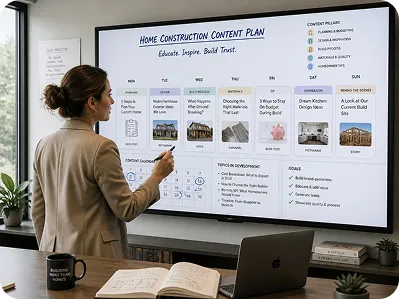

Step 4: Optimize Service, Location, Project, and Community Pages
Every important commercial page should make its service, market, and purpose clear to both search engines and buyers.
-
Strengthen titles, H1s, H2s, metadata, URLs, and on-page copy around genuine search intent.
-
Add internal links between related services, locations, communities, and projects.
-
Use relevant LocalBusiness, Organization, Service, and other appropriate structured data.
-
Make each location page genuinely useful rather than creating near-duplicate city pages.
-
Give every important page a clear conversion path such as consultation, quote, project inquiry, or contact.
Step 5: Publish Construction Content That Demonstrates Expertise
Build authority with content that reflects real construction knowledge, not generic SEO articles.
-
Publish project case studies, process guides, material comparisons, planning resources, and local market content.
-
Refresh older pages with current projects, regulations, materials, data, and customer questions.
-
Connect supporting articles back to core service and location pages.
-
Use first-hand project knowledge from builders, project managers, designers, and subject-matter experts.

Step 6: Build Local and Industry Authority
Construction SEO depends heavily on geographic relevance and credible industry signals.
-
Earn links and mentions from suppliers, architects, designers, trade organizations, local publications, chambers, and community organizations.
-
Strengthen local citations and keep business information consistent.
-
Promote completed projects and community involvement where appropriate.
-
Build relationships that create legitimate references to the builder’s expertise and work.
Step 7: Measure Rankings, Leads, and Construction-Specific Outcomes
Do not measure SEO for builders only by traffic. Connect search visibility to commercial outcomes.
-
Track impressions, clicks, CTR, rankings, and Top-10 coverage for priority construction terms.
-
Monitor service + location and project-intent queries separately.
-
Track qualified enquiries, consultation requests, quote requests, and assisted conversions.
-
Identify pages generating visibility but weak engagement, then improve intent match and conversion paths.
-
Review performance by service and market to decide where to expand or consolidate content.


Step 8: Strengthen AI Search Visibility and Brand Mentions
Construction buyers may also discover builders through AI-generated answers and search experiences. Make important expertise easy to understand and cite.
-
Structure pages with clear questions, direct answers, definitions, comparisons, and supporting evidence.
-
Strengthen consistent brand and expertise mentions across trusted construction, local, and industry sources.
-
Keep service, location, project, and company information consistent across the web.
-
Refresh high-value content as projects, services, markets, and construction information change.
Turn Local Search Into Signed Projects With MarketEngine’s AI-Powered SEO for Home Builders
SEO for builders becomes more effective when technical health, construction-specific content, local relevance, authority, and conversion paths work together. MarketEngine helps you increase visibility, generate demand, and drive more qualified leads with AI-powered SEO and marketing at 75% lower cost!
Key Takeaways
-
Website audits uncover hidden barriers limiting homeowner enquiries.
-
Keyword mapping aligns content with real buyer search intent.
-
Content clusters build authority across services, locations, and projects.
-
Consistent publishing strengthens rankings and long-term market visibility.
-
Authority signals and backlinks improve trust and search performance.
See how MarketEngine can help fill your pipeline with qualified homeowners.

Naren Patil
Founder & CEO, MarketEngine
Naren Patil is the former GM and Head of Product Marketing at Saba Learning, a $100 million business. He also served as SVP of Marketing and Demand Generation at NGDATA, Director of Product Marketing at Oracle, and Head of Product at TriNet.
Naren has spoken at TiECon Silicon Valley, Northwestern Kellogg, TiE Atlanta, and TiE Mumbai, and has been featured in publications such as Forbes. He holds an MBA from the Kellogg School of Management at Northwestern University.

FAQ
What is SEO for builders?


SEO for builders is the process of improving a construction company’s website and local presence so it ranks for relevant service, project, and location searches. It combines technical SEO, keyword strategy, content, local optimization, internal links, and authority building.
How long does SEO for builders take to work?
SEO timelines vary by market competition, website authority, technical condition, content quality, and location. Builders may see early visibility improvements within weeks, while stronger rankings and qualified enquiries typically require consistent work over several months.
What keywords should builders target?
Builders should target searches that combine their services, project types, and locations with buyer intent. Examples include custom home builder plus city, home builder plus community, remodeling service plus location, and construction services relevant to the projects they actually deliver.
Why does AI visibility matter for builders?
AI search can influence how buyers discover and compare builders. Clear service information, strong evidence, structured answers, and consistent third-party mentions can make a builder’s expertise easier for AI systems to understand and reference.
What is the difference between SEO for builders and general SEO?
SEO for builders must account for construction-specific services, project types, locations, longer buying cycles, and high-value decisions. It therefore requires stronger local relevance, project evidence, service pages, and content that supports construction buyer research.
How can builders improve local SEO?
Builders can improve local SEO by maintaining accurate business information, strengthening their Google Business Profile, creating useful service and location pages, earning relevant local mentions, collecting genuine reviews, and publishing content tied to the markets and projects they serve.
Can SEO help builders generate more qualified leads?
Yes. SEO can attract more qualified leads when pages target specific construction services, project types, and locations. Strong conversion paths, project proof, and clear service information help turn relevant search visibility into enquiries.
Should builders create separate pages for every city they serve?
Only when each location page provides genuinely useful, unique information. Creating near-duplicate pages for many cities can weaken quality. Strong location pages should reflect real service coverage, local context, relevant projects, and useful buyer information.
What is search engine marketing for construction?
Search engine marketing for construction combines paid and organic search tactics to increase visibility for relevant construction queries. It can support immediate campaign reach while SEO builds longer-term rankings and authority around services and locations.